Introduction
Ask anyone what a cigarette filter is made of, and the most common answer will be — cotton.
This assumption seems logical. The filter looks soft, fibrous, and harmless. But in reality, this belief is completely incorrect.
Cigarette filters are made of plastic, and not just any plastic — a processed polymer known as cellulose acetate. This misunderstanding is one of the main reasons cigarette butt pollution is underestimated.
What Is a Cigarette Filter Made Of?
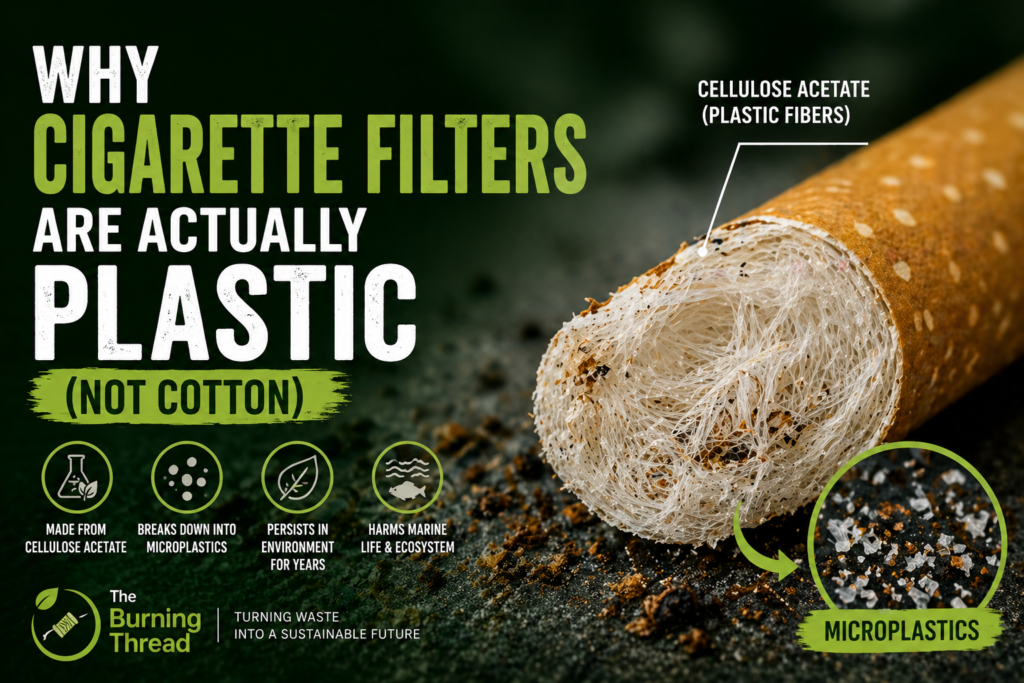
Cigarette filters consist primarily of cellulose acetate fibers, a semi-synthetic polymer derived from cellulose.
While the base material originates from plant cellulose, the chemical processing transforms it into a plastic-like substance with the following properties:
- High durability
- Resistance to biodegradation
- Ability to trap particulate matter
- Structural stability under heat and moisture
These characteristics make it effective as a filter — but highly problematic as waste.
Why It Is Not Cotton
Cotton is a natural fiber that biodegrades relatively quickly under environmental conditions.
Cellulose acetate, in contrast:
- Undergoes chemical acetylation, altering its structure
- Becomes resistant to microbial breakdown
- Persists in the environment for years
- Fragments into microplastics rather than decomposing
This distinction is critical. What appears to be a harmless natural fiber is, in fact, a long-lasting pollutant.
The Microplastic Problem
When discarded, cigarette filters do not simply disappear. Instead, they undergo photodegradation and physical fragmentation.
Over time, they break into microplastics, which:
- Enter soil and water systems
- Are ingested by marine organisms
- Accumulate in the food chain
- Pose long-term ecological risks
Cigarette butts are now recognized as a major contributor to microplastic pollution, particularly in coastal and urban environments.
Chemical Contamination
Beyond plastic pollution, cigarette filters act as carriers of toxic substances.
During smoking, the filter absorbs:
- Nicotine
- Tar
- Polycyclic aromatic hydrocarbons (PAHs)
- Heavy metals
When these filters are discarded, these chemicals can leach into the surrounding environment, compounding the pollution problem.
Why This Misconception Matters
If people believe cigarette filters are made of cotton, they are more likely to:
- Dispose of them casually
- Assume they will biodegrade
- Ignore their environmental impact
Correcting this misconception is essential for changing behavior and improving waste management practices.
Rethinking Waste as a Resource
Understanding that cigarette filters are composed of cellulose acetate opens up new possibilities.
Instead of treating them purely as waste, they can be:
- Chemically processed
- Converted into usable fibers
- Integrated into circular material systems
This perspective forms the foundation of innovations like The Burning Thread, where waste is re-engineered into sustainable products.
Conclusion
Cigarette filters are not cotton. They are a form of plastic engineered for performance but not for disposal.
Recognizing this reality is a critical step toward addressing one of the most overlooked sources of pollution.
Awareness leads to accountability.
Accountability leads to innovation.